
How to Read a Certificate of Analysis (COA)
A plain-language guide for research buyers
When you purchase research materials, the Certificate of Analysis, or COA, is the single most important document you receive. It is the lab report that tells you what is actually in the vial. A supplier who tests every lot and publishes the results is showing their work. A supplier who cannot produce a lot-specific COA is asking you to take their word for it.
This guide walks through what each part of a COA means, so you can evaluate any research material with confidence, whether you buy it from us or anywhere else.
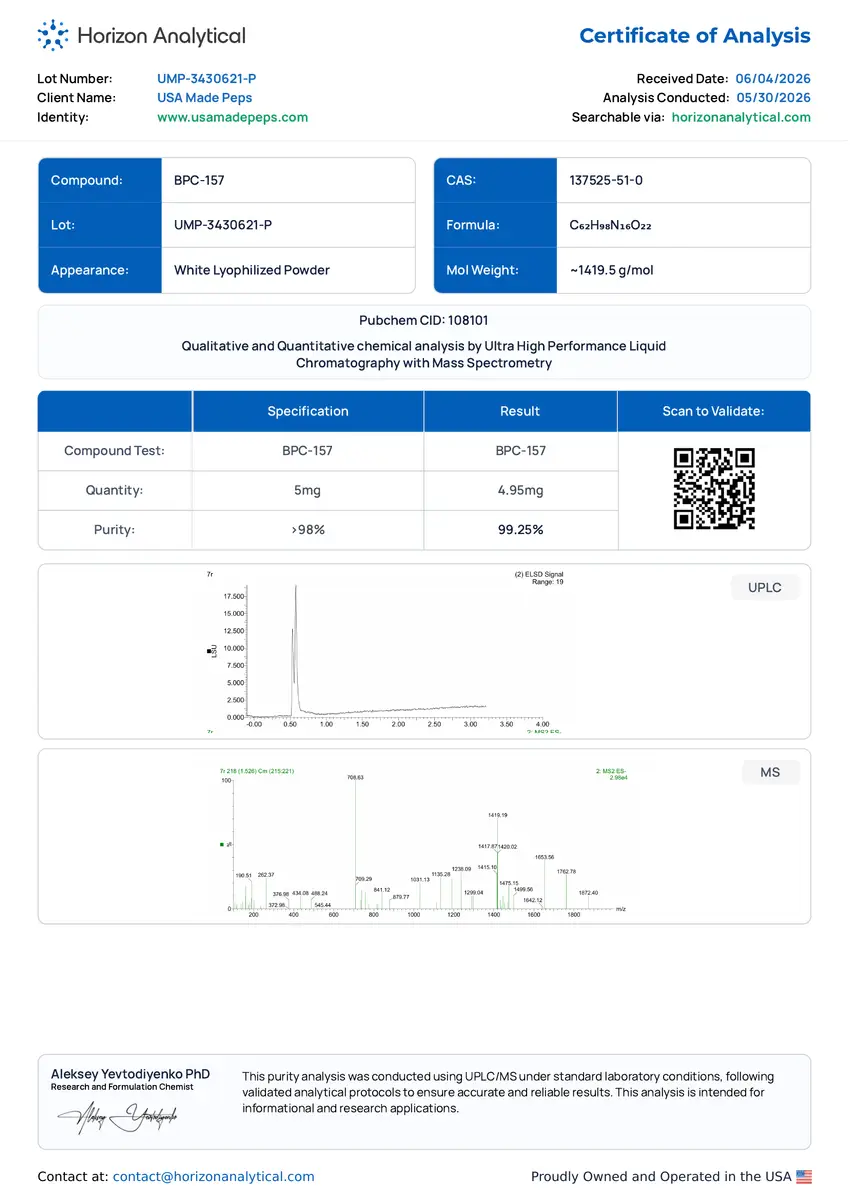
One of the clearest signs of a trustworthy COA is that you can verify it independently. The results should come from a third-party laboratory, not the seller’s own bench, and you should be able to reach that lab directly. A good COA makes this easy. The certificate above lists Horizon Analytical as the testing lab, and it links straight to their records, so you can confirm both the results and that the company behind them is real. When you evaluate any supplier, look for that same chain: an independent lab, named on the document, whose results you can confirm for yourself.
This COA example is a real certificate from one of our lots. Scan its QR code and it takes you to Horizon Analytical’s secure verification portal. Enter the lot number shown on the certificate, UMP-3430621-P, and their system pulls up the full report so you can confirm the results firsthand.
What a Certificate of Analysis Is
A COA is a document produced by an analytical laboratory that reports the results of testing performed on a specific batch, or lot, of material. The key word is specific. A real COA is tied to one production lot and reflects testing on that exact material, not a generic result copied across every batch.
At USA Made Peps, every product lot is third-party tested, and the COA for your lot is available through our verification tool at usamadepeps.com/verify. You can look up your lot and see the testing data for the exact material you received.
The Key Sections of a COA
Most certificates share a common structure. Here is what to look for and what each part is telling you.
Product Identity
This is the name of the compound and often its sequence or chemical identifiers. On a peptide COA you will typically see the amino acid sequence and the molecular formula. This section confirms that the material tested is the compound it claims to be. If the identity section is missing or vague, that is a red flag.
Lot or Batch Number
Every COA should reference a unique lot number that matches the label on your product. This is how you confirm the certificate actually corresponds to what is in your hands. If the lot number on the COA does not match the vial, the document is not describing your material.
Purity and HPLC Results
Purity is usually the number buyers focus on most, and for good reason. It is most commonly measured by High-Performance Liquid Chromatography, abbreviated HPLC. HPLC separates the components of a sample so the lab can measure how much of the material is the target compound versus impurities or byproducts.
A purity result of greater than or equal to 98 percent by HPLC means the lab found the target compound made up at least 98 percent of the sample. Higher is better. The COA will often include the actual chromatogram, the graph HPLC produces, where the target compound appears as a dominant peak. A clean chromatogram with one clear dominant peak is what you want to see.
Mass Spectrometry and Identity Confirmation
Purity tells you how much of the sample is the target compound. Mass spectrometry, often abbreviated MS, confirms that the compound is what it is supposed to be by measuring its molecular weight. When the measured mass matches the known molecular weight of the compound, that is strong confirmation of identity. Many quality COAs pair HPLC purity with MS identity confirmation, so you get both questions answered: how pure, and is it really the right molecule.
Appearance and Physical Description
This section notes the physical form of the material, for example a white lyophilized powder. It is a simple visual quality check. A description that does not match what you received is worth questioning.
Test Date and Laboratory Information
A credible COA identifies when the testing was performed and, ideally, which laboratory performed it. Third-party testing, meaning testing done by an independent lab rather than the seller, carries more weight because the lab has no stake in the result.
How to Actually Use a COA
Reading a COA comes down to a short checklist:
Confirm the lot number on the certificate matches your product label. Check that the purity meets the stated specification, for example greater than or equal to 98 percent. Look at the chromatogram for a single dominant peak rather than a noisy result with many peaks. Confirm the identity section names the correct compound and, where present, that mass spec confirms the molecular weight. Note whether the testing was third-party.
If all of those line up, you have a document that actually stands behind the material.
Why This Matters for Research Integrity
Research is only as reliable as the materials it uses. Working with a compound of unknown purity or uncertain identity introduces a variable you cannot control and cannot account for in your results. A lot-specific COA removes that uncertainty. It is the difference between assuming your material is what the label says and knowing it.
This is why testing transparency is central to how USA Made Peps operates. Every lot is third-party tested, and every COA is available for lookup through our verification tool. You do not have to request it or take anything on faith.
Verify Your Lot
If you have received a product from USA Made Peps, you can look up the COA for your specific lot at usamadepeps.com/verify. Enter your lot number to see the testing data for the exact material you received.
A COA is one piece of the picture. Pair it with our guides on how to vet a research peptide supplier and how to store research peptides to research with confidence.
All products sold by USA Made Peps are for Research Use Only. They are not drugs, foods, dietary supplements, or medical devices, and are not intended for human or veterinary use, ingestion, injection, or any form of in vivo administration. This content is provided for scientific and educational purposes only.
Explore the catalog
Every compound in our catalog is finished in the United States from imported peptide APIs (purified, filled and lyophilized domestically) and independently third-party tested, with a Certificate of Analysis you can verify by lot. Browse the catalog or verify a lot.
Want to check our work yourself? We will replace any vial you send to an independent lab for testing, free of charge, pass or fail. See Don’t Trust Us. Test Us. for how the program works.
Still have questions? Our frequently asked questions page covers ordering, testing, storage and shipping.